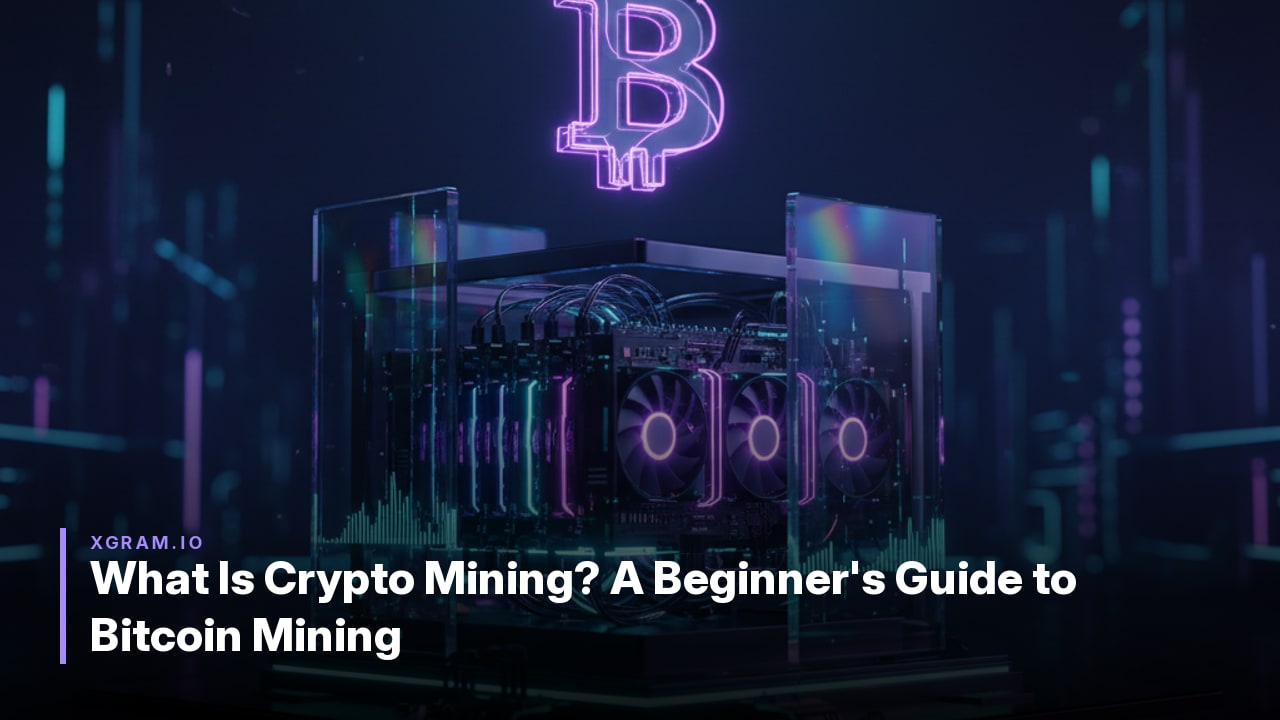
What Is Crypto Mining? A Beginner's Guide to Bitcoin Mining


By Sophie Lindqvist · Reviewed by Viktor Andersson
Date: June 15, 2026 | Updated: 15.06.2026
Crypto mining is how new coins enter circulation and how networks like Bitcoin stay secure: miners race to solve compute-heavy puzzles that validate transactions and earn block rewards. This beginner's guide covers how it works, what the hardware and electricity actually cost, and whether mining is still worth it in 2026.
What Is Crypto Mining?
At its core, crypto mining is the process of validating and adding transactions to a blockchain ledger. For Bitcoin, this requires solving complex mathematical problems that secure the network and verify transactions. Miners contribute their computational power to this process, and in return, they are rewarded with newly minted Bitcoins and transaction fees.
How Does Bitcoin Mining Work?
The Bitcoin network operates on a proof-of-work consensus mechanism. This means that miners must compete to solve cryptographic puzzles, which require significant computational resources. Here’s an overview of how the mining process works:
- Transaction Data: When someone sends Bitcoin, that transaction is broadcasted to the network.
- Block Creation: Transactions are grouped together into blocks. Each block contains a list of transactions and a reference to the previous block, creating a chain.
- Hashing: Miners compete to solve a mathematical puzzle, which involves finding a hash value that fits certain criteria. This process is computationally intensive.
- Validation: The first miner to solve the puzzle gets to add the block to the blockchain and is rewarded with newly minted Bitcoins.
- Propagation: The newly created block is then propagated across the network, and other nodes validate the block before it is officially accepted.
The Equipment Needed for Mining
When I first started looking into Bitcoin mining, the variety of equipment options was overwhelming. Today, the landscape is dominated primarily by specialized hardware known as ASICs (Application-Specific Integrated Circuits), which are designed specifically for mining Bitcoin. Here’s a breakdown of the main types of mining hardware:
| Type of Hardware | Description | Cost Range | Hash Rate (TH/s) |
|---|---|---|---|
| ASIC Miners | Optimized for Bitcoin mining, providing high efficiency and power. | $1,000 - $15,000 | 10 - 140 |
| GPU Miners | General-purpose hardware, more versatile but less efficient for Bitcoin. | $500 - $3,000 | 1 - 8 |
| CPU Miners | Not recommended for Bitcoin mining due to low efficiency. | $100 - $1,000 | 0.1 - 1 |
Mining Pools vs. Solo Mining
When I started, I was eager to try solo mining but quickly realized that competing against large mining farms was nearly impossible. Most miners today join mining pools, which are groups of miners that combine their computational power to increase the chances of solving a block. Here are the pros and cons of each approach:
- Mining Pools:
- Higher probability of earning rewards.
- Consistent payouts based on contribution.
- Reduced variance in rewards.
- Solo Mining:
- Full control over the mining process.
- Potential for higher rewards if successful.
- Higher risk and reward variance.
The Economics of Bitcoin Mining
Mining Bitcoin is not just about hardware; it’s also about economics. The cost of electricity and the price of Bitcoin play a crucial role in determining profitability. As of mid-2026, the average cost of electricity for mining operations ranges between $0.06 to $0.12 per kilowatt-hour (kWh), depending on the location. Here’s a breakdown of key economic factors:
Costs Associated with Mining
- Hardware Costs: Initial investment in mining rigs.
- Electricity Costs: Ongoing operational expenses based on consumption.
- Cooling Costs: Additional expenses for maintaining optimal temperatures in mining facilities.
- Pool Fees: If participating in a mining pool, a percentage of earnings goes to the pool operator.
Potential Earnings
In 2026, the current Bitcoin block reward is 6.25 BTC per mined block, which is halved approximately every four years. Based on the current trajectory, Bitcoin's price is projected to reach $100,000 by 2030, making the potential earnings from mining quite lucrative if prices remain favorable.
Risks and Best Practices
While mining Bitcoin can be profitable, it’s essential to understand the associated risks and adopt best practices to minimize potential losses.
- Market Volatility: Bitcoin prices can fluctuate significantly, impacting profitability.
- Regulatory Risks: Mining operations may face legal and regulatory challenges depending on the jurisdiction.
- Hardware Risks: Equipment can fail, or become outdated quickly due to technological advancements.
- Environmental Concerns: The energy consumption of Bitcoin mining has drawn criticism regarding its environmental impact.
Best Practices
- Monitor energy costs and seek cheap electricity options.
- Stay updated on the latest mining hardware and software developments.
- Consider joining reputable mining pools to enhance profitability.
- Diversify your investment portfolio by exploring other cryptocurrencies and DeFi projects.
Conclusion
Reflecting on my initial experience with Bitcoin mining, it’s fascinating to see how this process has grown and adapted over the years. From a simple concept to a sophisticated industry, crypto mining remains an integral part of the blockchain ecosystem. As we look towards the future, I believe that with strategic planning and an informed approach, anyone can explore the world of Bitcoin mining and potentially reap its rewards. If you’re interested in crypto swaps without creating an account, check out Xgram.io for a registration-free experience where most swaps complete without KYC. Whether you’re an aspiring miner or an investor, understanding the dynamics of mining is crucial in navigating the crypto landscape.
What are your thoughts on Bitcoin mining? Have you tried it or thought about starting? Share your opinions in the comments below!
This is not financial advice.

Private crypto swaps
Best rates. Secure. Wallet to wallet

 5 Min
5 Min