What Is Copium in Crypto? Meaning, Origin and Real Examples


In crypto communities, copium crypto describes the denial and rationalization traders use when facing losses. Copium is internet slang for a coping mechanism that involves denial or rationalization when facing loss, failure, or disillusionment. It functions as a metaphorical opiate that helps people detach from unwelcome realities rather than confront them directly.
What Copium Means
The word itself is a blend of “cope,” the act of dealing with adversity, and “opium,” the drug. Merriam-Webster defines it as denial or rationalization of defeat or failure, imagined as a drug, and added the term to its dictionary in a September 2026 update covering roughly 1,400 new words.
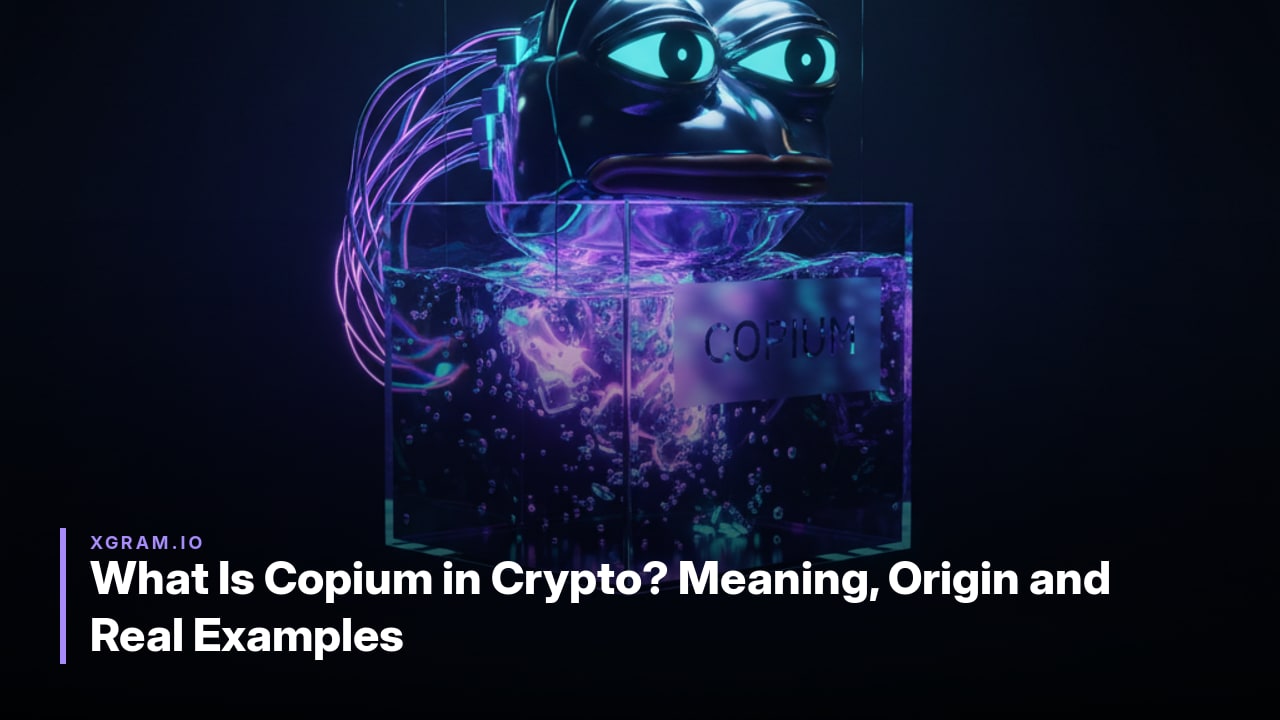
Common phrases include “huffing copium,” “hitting the copium,” and “on copium.” These expressions often appear alongside the Pepe the Frog meme, in which the character is shown connected to a tank or mask labeled “copium.” The term originated on 4chan and quickly spread to other online communities where users apply it to anyone refusing to accept a negative outcome.
Origin and Popularization
The earliest documented use of “copium” appears on the 2003 album by Keak da Sneak, where the word functioned as a blend of “cope” and “opium.” Wiktionary’s September 19, 2026 entry cites this album as the primary origin point while noting possible independent coinages during the 2000s.
The term remained niche until it surfaced on 4chan imageboards. Know Your Meme records scattered 2018 threads, yet the phrase only achieved wider recognition in 2019–2020 when it was paired with Pepe the Frog imagery. The meme typically depicts the character inhaling from a tank labeled “copium,” turning the abstract concept into a repeatable visual gag.
From 4chan the expression spread to Reddit, Twitter (now X), and crypto forums. Merriam-Webster formalized its acceptance in the September 2026 dictionary update, adding the word alongside roughly 1,400 other new entries; the slang page received its last revision on September 10, 2026. The update defines copium as denial or rationalization of defeat imagined as a drug, matching the usage already established on imageboards and social platforms.
Copium in Crypto Markets
In crypto markets the term describes holders who refuse to exit losing positions even after clear price declines. Traders instead rationalize continued ownership by repeating phrases such as “just a dip,” “still early,” “fundamentals unchanged,” or “whales manipulating the price.” These statements serve as a coping mechanism that detaches the investor from the evidence of permanent loss.
The behavior differs from hopium, which centers on unfounded optimism about future gains. Copium specifically addresses denial of an already realized negative outcome. When a position drops sharply, affected investors often double down on the original thesis rather than reassess it, extending holding periods and increasing realized losses once liquidation or capitulation finally occurs.
Market volatility amplifies the pattern. Rapid drawdowns on platforms like X, Reddit, and Telegram trigger clusters of posts that repeat the same rationalizations, reinforcing group denial. Secondary accounts of the 2022 Terra/LUNA-UST collapse and the FTX failure illustrate the dynamic: participants maintained narratives of recovery long after on-chain and balance-sheet data contradicted them. The result is delayed decision-making that turns temporary paper losses into larger realized ones. The mindset persists because crypto markets reward early conviction yet punish the refusal to update that conviction when facts change.
Real-World Examples from Major Events
During the 2022 Terra LUNA-UST collapse, holders repeatedly framed the depeg as a temporary technical issue rather than a structural failure. Comments such as “the peg will return once the arbitrage bots stabilize” and “this is just a liquidity crunch, not a fundamental problem” appeared across discussion threads as the algorithm continued to unwind.
Participants also invoked “whales are manipulating the price” to explain the accelerating sell pressure, shifting focus away from the broken mechanics of the stablecoin system. The same pattern repeated when UST lost its dollar link permanently: narratives shifted to “the team will relaunch a stronger version” instead of acknowledging the permanent loss of value.
The FTX failure produced parallel examples. Traders facing frozen withdrawals often posted that “this is coordinated FUD from rival exchanges” or “Sam will secure new funding any day now.” Even after the balance-sheet shortfall became public, some accounts insisted the platform remained solvent and that external pressure alone had created the run.
These cases show copium operating through specific denial phrases that reinterpret clear evidence of insolvency or protocol failure as external or transient events. The language stayed consistent across both crises, allowing holders to maintain positions without confronting the underlying facts.
Copium Compared to Related Terms
Copium centers on denial after a loss has already occurred, whereas hopium centers on unfounded expectations of future gains. The distinction appears most clearly in timing and the specific emotion each term targets.
| Term | Core Meaning | Timing of Use | Emotional Focus |
|---|---|---|---|
| Copium | Rationalization of an existing negative outcome | After price drops or project failures | Detachment from current reality |
| Hopium | Baseless optimism about future upside | During uncertainty or before events | Projection of positive results |
| FOMO | Fear of missing out on gains | During rapid price rises | Anxiety-driven action |
| FUD | Spread of fear, uncertainty, and doubt | To influence selling or avoidance | Negative emotional pressure |
The table shows that copium activates once evidence of loss exists, while hopium operates before any outcome is confirmed. FOMO and FUD differ further by emphasizing immediate emotional reactions rather than post-event coping. In practice, traders may move from hopium into copium when an anticipated rally fails to materialize, revealing how the terms describe sequential stages of the same denial process rather than interchangeable ideas.
FAQ
How is copium used in crypto discussions?
Traders apply the term when others defend losing positions with phrases such as “just a dip,” “still early,” or “whales are manipulating the price,” even after clear evidence of permanent loss.
What is the difference between copium and hopium?
Copium describes denial of an existing negative outcome, while hopium refers to baseless optimism about future gains that have no supporting evidence.
What does the copium meme look like?
The most common visual shows Pepe the Frog wearing a mask or connected to a tank labeled “copium,” illustrating the idea of inhaling a coping mechanism.
How can you recognize the copium mindset in online threads?
Watch for repeated rationalizations that dismiss market data or project failures, especially after events like the 2022 Terra/LUNA-UST collapse or the FTX bankruptcy.
When did Merriam-Webster add copium to its dictionary?
The entry appeared in the September 2026 update that introduced roughly 1,400 new words, with the slang definition focusing on denial or rationalization of defeat.
Is the copium meme limited to crypto?
No. The term originated on 4chan and spread across broader internet culture before becoming frequent in cryptocurrency forums and social media.

Private crypto swaps
Best rates. Secure. Wallet to wallet


 5 Min
5 Min