Monero Delistings in 2026: Full Timeline and What to Do


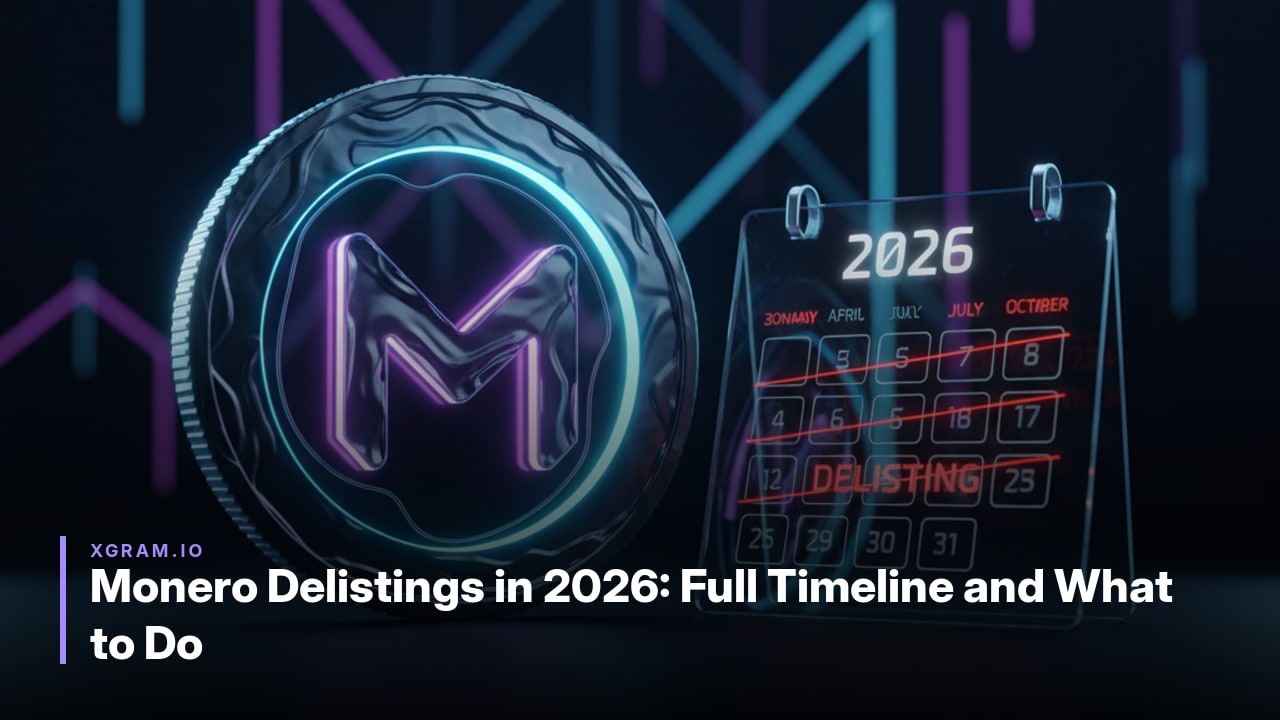
Monero delistings in 2026 continued the compliance-driven trend that began in 2024, as centralized exchanges responded to regional restrictions on privacy coins.
Quick Answer
Monero delistings in 2026 were limited to targeted regional actions by Kraken in India and the UAE. Most users can still access XMR via KuCoin, MEXC, Gate.io, TradeOgre, or non-custodial atomic swaps and registration-free swaps on platforms such as xgram.io (no KYC for most swaps, though identity verification may be requested in specific compliance situations).
Regulatory Drivers Behind the Delistings
Monero (XMR) delistings result from centralized exchanges aligning with AML/KYC rules and specific restrictions on privacy coins. These policies target assets that obscure transaction details, prompting platforms to remove trading pairs to meet compliance standards rather than risk enforcement actions.
The EU Anti-Money Laundering Regulation (AMLR, Regulation 2024/1624, Article 79) bans regulated crypto service providers from offering anonymity-enhancing coins including XMR beginning July 10, 2027. Self-custody of Monero stays unaffected under this framework.
Ownership and personal use of XMR remain legal across major jurisdictions such as the US, EU, UK, and Canada. The removals reflect exchange-level compliance decisions instead of outright bans on holding the asset.
Complete Timeline of Monero Delistings 2024-2026
The 2024 wave started with global centralized exchanges. OKX removed XMR on January 5. Binance followed on February 20. Kraken completed its EEA exit on October 31, with forced conversions required by early January 2025.
One tracker recorded 73 delistings of XMR and other privacy coins across exchanges in 2025.
Regional restrictions took center stage in 2026. Kraken halted deposits and trading for Indian clients on April 10, stopped withdrawals on May 15, and completed liquidation May 18–22. The UAE process began with a deposits and trading halt on June 16, followed by a withdrawals halt on September 14 and liquidation September 15–25.
Mining pools also exited. SoloPool.org ended XMR support on May 30. DxPool shut its pool on September 24. No further global CEX delistings were documented in the second half of the year beyond these targeted measures.
Remaining Venues Versus Delisted Options
Access to Monero has narrowed to a handful of centralized exchanges that still list XMR alongside decentralized routes. KuCoin, MEXC, Gate.io and TradeOgre continue to offer spot trading, while Kraken remains available outside the EEA. These platforms require account registration and comply with AML screening.
Decentralized alternatives have expanded. Haveno-based P2P networks and BTC-to-XMR atomic swaps through UnstoppableSwap or BasicSwap allow users to trade without creating an account on a central platform. Registration-free swaps on services such as xgram.io fit into this category, completing most transactions without identity verification unless compliance flags arise.
| Category | Examples | Registration | Status |
|---|---|---|---|
| Active CEX | KuCoin, MEXC, Gate.io, TradeOgre, Kraken (non-EEA) | Required | Operational |
| P2P / Atomic | UnstoppableSwap, BasicSwap, Haveno networks, xgram.io | None for most swaps | Operational |
| Closed | LocalMonero, various 2024-2025 CEX pairs | Previously required | Shut down |
Liquidity now splits across these channels, with atomic-swap tools gaining use for users seeking to avoid additional account creation. Self-custody wallets remain unaffected by venue restrictions.
Market Impact: Liquidity, Spreads and Price Data
In late September 2026 Monero held a price range of approximately $541–$556 USD, producing a market capitalization of $10.1–$10.2 billion on a circulating supply near 18.8 million coins.
Delistings have fragmented available liquidity across fewer centralized venues and a growing set of decentralized routes. One August 2026 snapshot recorded a median 2.55 percent gap between the highest and lowest quotes shown by providers at any single moment.
Wider spreads directly raise the cost of entry and exit for holders who must route orders through remaining platforms or atomic-swap tools. Price discovery slows because liquidity no longer concentrates on a handful of deep order books, forcing participants to compare multiple sources before executing.
Regional restrictions, such as Kraken’s staged halts for Indian and UAE clients, further split pools of capital that once flowed through a single interface. The resulting dispersion shows up most clearly in quote variance rather than headline volume totals, which remain unreported in aggregate across all venues.
Traders therefore face execution risk that scales with the number of venues they must check, even when the underlying asset price itself moves within a relatively narrow band.
What to Do: Practical Steps for XMR Holders
Holders facing reduced access on major platforms should first withdraw XMR to self-custody wallets. This move shields assets from the forced liquidations or deposit halts observed in Kraken's India and UAE actions during 2026.
Once in personal control, users retain the ability to transact regardless of future centralized restrictions. Non-custodial storage also sidesteps the EU AMLR prohibition on regulated providers handling XMR from July 10, 2027 onward.
For liquidity needs, atomic swaps offer a direct path between BTC and XMR via tools such as UnstoppableSwap or BasicSwap. These operate without order books and have grown in use as exchange options narrowed.
Registration-free swaps provide another route on select platforms, with no KYC for most swaps although identity verification may be requested in specific compliance situations. Disclosure: xgram.io is a partner.
Practical steps include the following sequence:
- Confirm remaining balances on venues such as KuCoin, MEXC, Gate.io or TradeOgre and execute withdrawals to a verified wallet address.
- Cross-check the Monero blockchain explorer to confirm receipt before any further activity.
- Test small atomic-swap transactions on UnstoppableSwap or BasicSwap to understand current rates and execution times.
- Monitor regulatory announcements, especially EU implementation details and any regional updates from remaining exchanges, to adjust plans ahead of the 2027 AMLR deadline.
Regular review of these decentralized options keeps holders prepared as liquidity continues to fragment across fewer venues.
FAQ
Do I need KYC to swap Monero now?
Xgram does not require KYC for most swaps. However, transactions flagged by compliance procedures may be subject to additional review and identity verification. Most users complete registration-free swaps without providing documents.
Which exchanges still list Monero in 2026?
KuCoin, MEXC, Gate.io, TradeOgre and Kraken outside the EEA continue to offer XMR trading. Kraken ended support for users in India and the UAE through staged halts ending in September 2026.
What are the best current on-ramps for XMR?
Atomic-swap tools such as UnstoppableSwap and BasicSwap plus Haveno-based P2P networks provide registration-free access. Liquidity has fragmented, with wider spreads reported in August 2026 snapshots.
Are Monero mining pools still operating?
SoloPool.org removed XMR support on May 30, 2026. DxPool shut its Monero pool on September 24, 2026. Miners must locate remaining pools or switch to solo setups.
What changes in July 2027 under EU rules?
The EU Anti-Money Laundering Regulation prohibits regulated providers from handling Monero from July 10, 2027. Self-custody and non-custodial swaps remain unaffected.
Can I still mine Monero profitably?
Profitability depends on hardware efficiency and electricity costs. Pool closures have pushed some miners toward decentralized options or other coins while XMR price held near $550 in late September 2026.

Private crypto swaps
Best rates. Secure. Wallet to wallet