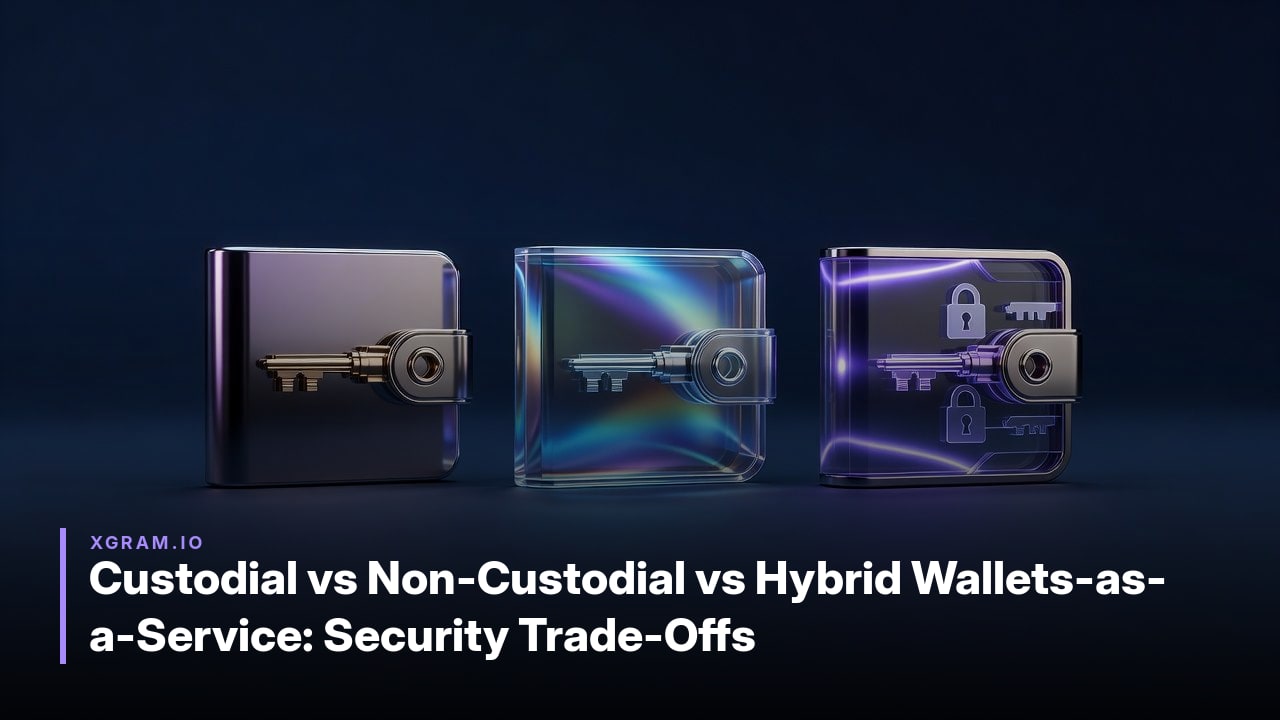
Custodial vs Non-Custodial vs Hybrid Wallets-as-a-Service: Security Trade-Offs


Wallet Custody Models Explained
Custodial wallets give the service provider complete possession of private keys. Users sign in with credentials to view balances and authorize transfers, but the platform executes every on-chain action and can freeze or move assets at any time.
Non-custodial wallets keep private keys solely with the owner. The software or interface only broadcasts signed transactions; it never receives, stores, or recovers the keys, leaving the user responsible for seed phrases, device security, and transaction verification.
Hybrid wallets-as-a-service split key material between user and provider through methods such as multi-party computation or threshold signatures. The service can assist with backup, policy enforcement, or transaction pre-signing, yet cannot spend funds without the user’s portion of the key.
These distinctions determine interaction patterns. Custodial models rely on account logins and support tickets; non-custodial models require direct wallet connection and manual approvals; hybrid models blend both by offering guided flows while still demanding user key participation for final authorization.
Security Profile of Custodial Wallets
When a third party holds private keys, custodial wallets introduce concentrated risk around that single custodian. A compromise of the provider’s systems can expose every user’s assets at once, because recovery depends entirely on the custodian’s backup procedures and internal access controls.
Regulatory seizure represents a second distinct threat. Governments or courts can order the custodian to freeze or surrender funds linked to specific addresses, often with limited notice to users. This capability stems directly from the custodian’s legal control over the keys and its obligation to comply with jurisdiction-specific mandates.
Offsetting these exposures, established custodians typically deploy enterprise security stacks, including hardware security modules, segregated cold storage, and regular third-party audits. Some maintain insurance policies that reimburse losses from certain external hacks or employee misconduct, though coverage terms vary and often exclude regulatory actions.
Users must still assess the custodian’s governance, incident history, and reserve policies, because any failure in those areas directly translates into permanent loss of access to the underlying assets.
Security Profile of Non-Custodial Wallets
Non-custodial wallets shift complete key management to the individual user. This removes reliance on any external custodian but creates direct exposure to several preventable failures.
Seed-phrase loss stands as the most common irreversible event. Once a 12- or 24-word phrase disappears or is destroyed, no service can restore access because the keys were never stored elsewhere. Device compromise through malware or physical theft allows attackers to extract private keys stored on the compromised hardware. Phishing remains effective because users must interact directly with their keys during transactions or wallet restores, giving attackers repeated opportunities to capture credentials.
The absence of third-party recovery options means every user error carries permanent consequences. Forgotten passwords, misplaced hardware, or accidental deletion of backup files result in total fund loss without appeal. Multi-signature configurations and hardware wallets reduce some vectors but increase operational complexity and still leave the user responsible for securing all signing devices and phrases.
Users therefore face ongoing requirements for disciplined backup practices, regular device hygiene, and verification of every transaction detail before approval.
Security Profile of Hybrid Wallets-as-a-Service
Hybrid Wallets-as-a-Service divide private-key control between the user and the service provider. The provider typically manages one or more key shares while the user retains the remainder, so neither party alone can move funds.
Multi-party computation and threshold signatures enable this split. MPC protocols let several parties jointly compute a signature without assembling the full key in any single location. Threshold schemes require a configurable number of shares, for example three-of-five, to authorize a transaction. This design removes the single point of failure common in fully custodial setups and reduces the seed-phrase exposure risk of pure non-custodial wallets.
Attack vectors remain. If an adversary compromises the provider’s infrastructure and obtains enough shares, or tricks the user into approving a malicious transaction through social engineering, funds can still be drained. Side-channel leaks during MPC rounds, flawed randomness generation, or misconfigured threshold parameters also create exploitable weaknesses. Users must therefore verify the provider’s security practices and maintain strong device-level protections on their own shares.
Security Trade-Off Comparison
The three custody models differ sharply once the same criteria are applied side by side. The table below summarises the decisive dimensions.
| Aspect | Custodial | Non-Custodial | Hybrid Wallets-as-a-Service |
|---|---|---|---|
| Private-Key Control | Provider holds full control; user has no direct access. | User holds sole control via seed phrase or hardware device. | Keys split between user and service via MPC or threshold schemes. |
| Recovery Methods | Account recovery via email, KYC documents or support tickets. | Only seed-phrase restoration; no third-party fallback. | Multi-party recovery that can still require user approval for final release. |
| Regulatory Exposure | High; provider subject to AML, licensing and data-retention rules. | Minimal; user bears compliance obligations when interacting with regulated services. | Moderate; service layer faces oversight while user portion remains off-balance-sheet. |
| Smart-Contract Risk | Low, as assets sit in provider-controlled hot or cold storage. | High when funds interact with DeFi protocols or custom contracts. | Medium; limited exposure through audited service contracts but user-controlled portion still vulnerable. |
| Typical User Error Impact | Low; mistaken transactions can often be reversed by support. | High; lost seed or wrong address results in permanent loss. | Medium; policy-based approvals reduce but do not eliminate irreversible mistakes. |
Traders who value convenience accept custodial regulatory risk and counterparty exposure. Those prioritising sovereignty accept total responsibility for key management and smart-contract interactions. Hybrid solutions attempt to split the difference by keeping part of the key with the user while outsourcing recovery and compliance functions, yet they still introduce smart-contract dependencies that pure non-custodial wallets can avoid entirely.
FAQ
How do I choose the right wallet model for my needs?
Match the model to your priorities: custodial for simplicity and recovery options, non-custodial for full control over keys, and hybrid Wallets-as-a-Service for balanced features with managed infrastructure. Consider how often you trade and whether you prefer self-custody during swaps.
When is identity verification requested during swaps?
Identity verification may be requested in specific compliance situations, such as large transaction volumes or flagged activity. Most routine operations on registration-free platforms avoid this step entirely.
Can registration-free swaps integrate with custodial wallets?
Yes. Registration-free swaps connect directly to custodial services by using API access or linked addresses, allowing users to initiate trades without creating a new account while the custodian handles key management.
How do non-custodial wallets support registration-free swaps?
Non-custodial wallets let users sign transactions locally. Registration-free swaps integrate by connecting via wallet extensions or QR codes, keeping private keys off the platform and enabling direct execution on-chain.
What compliance processes apply to hybrid wallet services?
Hybrid models run transaction monitoring and AML screening in the background. Registration-free swaps proceed normally unless a compliance review triggers additional checks, at which point identity verification may apply.
Do all wallet types allow crypto swaps without creating an account?
Most wallet types support registration-free swaps through external connectors. Custodial and hybrid options may route through partner interfaces, while non-custodial wallets connect directly via on-chain protocols.

Private crypto swaps
Best rates. Secure. Wallet to wallet

 5 Min
5 Min