Crypto Wallet vs Crypto Exchange: Where Should You Keep Your Coins?


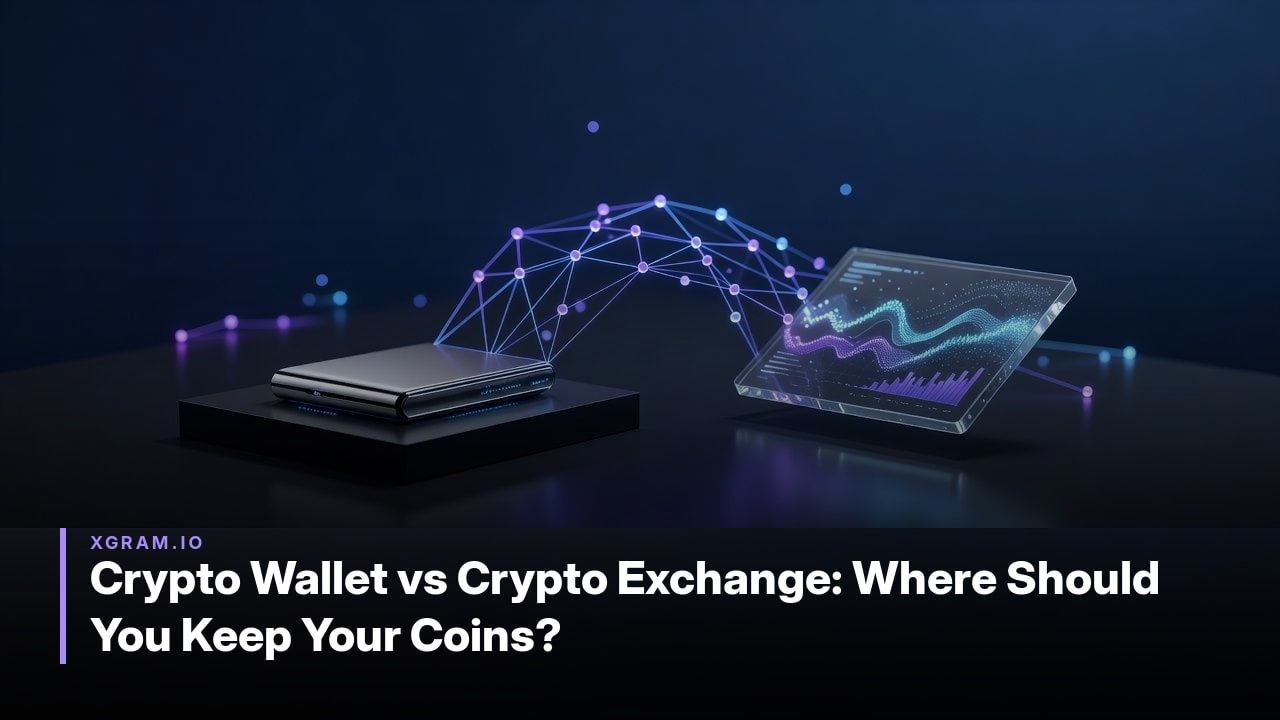
Deciding between a crypto wallet and crypto exchange comes down to how much control, security, and convenience you need when holding coins.
Core Differences in How Exchanges and Wallets Hold Assets
Custodial exchange accounts keep user funds under the platform’s control. Traders deposit coins to an exchange wallet, but the service holds the private keys and can move or freeze those assets at any time. This setup mirrors a bank deposit: the exchange records a balance in its database while the actual cryptocurrency remains in addresses it manages.
Non-custodial wallets operate differently. The user generates and stores the private keys locally or on hardware. Ownership is proven by signing transactions with those keys, so no third party can access the funds without the seed phrase. The phrase “not your keys, not your coins” describes this direct control.
Private-key ownership determines recovery options and counterparty risk. Losing keys on a non-custodial wallet means permanent loss of access. On a custodial exchange, forgotten passwords can usually be reset through support, yet users must trust the platform against hacks or freezes.
Many traders now perform quick conversions on registration-free swaps. Services like xgram.io complete most swaps with no KYC, though identity verification may be requested in specific compliance situations. This approach removes the need to deposit assets into a custodial account for simple trades.
Security Trade-offs and Real-World Risks
Exchanges hold large pools of customer assets that become high-value targets for organized attacks. When breaches occur, entire user bases can lose access simultaneously, with recovery depending on the platform's reserves and insurance policies that often fall short. Account freezes introduce further disruption, as compliance teams may lock withdrawals during regulatory reviews or fraud probes, stranding funds during critical market moves.
Self-custody removes the platform layer yet exposes holders to permanent personal failures. Seed-phrase loss through forgotten backups or device destruction ends access with no appeal process. Phishing attacks have evolved to intercept transaction approvals via cloned sites and urgent support messages, draining wallets before users detect the deception.
Additional self-custody risks include malware that replaces wallet addresses during copy-paste operations and SIM-swapping attempts that intercept two-factor codes. Exchange users instead face systemic issues such as delayed support responses after credential theft and sudden policy shifts that limit withdrawals across regions. Both models carry documented loss events, though the triggers differ between institutional code failures and individual operational oversights. Effective mitigation requires tailored defenses: exchanges demand verification of platform solvency and withdrawal policies, while self-custody demands rigorous key-management routines that still cannot guarantee against every human error.
Speed, Liquidity and Daily Usability
Centralized exchanges let traders execute buys and sells in seconds because assets already sit inside the platform’s order books. Liquidity pools are deep for major pairs, so market orders rarely slip more than a few basis points. In contrast, moving coins from a self-custody wallet to an exchange for the same trade requires a blockchain transaction, multiple confirmations, and sometimes manual review, adding anywhere from ten minutes to several hours depending on network congestion.
Daily usability follows the same pattern. Frequent traders who keep balances on exchanges avoid repeated on-chain fees and wait times, while long-term holders who withdraw to hardware wallets accept slower access in exchange for offline security. When the need arises to swap without first depositing to a custodial platform, registration-free swaps provide an alternative route. Services such as xgram.io execute these swaps directly from the user’s wallet with fast execution, bypassing the deposit-and-withdraw cycle for most transactions. Identity verification may be requested in specific compliance situations, yet the majority of swaps complete without creating an account.
The practical trade-off is therefore clear: keep working capital on an exchange when speed and tight spreads matter most; move larger or infrequently used holdings to a wallet and rely on registration-free swaps only when an immediate trade is required.
Fee Structures and Ongoing Costs
Centralized exchanges apply trading fees on every buy or sell, commonly 0.1 percent to 0.5 percent in a maker-taker structure, plus withdrawal charges that vary by asset and can include both a fixed platform fee and the underlying network fee. These costs accumulate for active traders who move funds on and off the platform regularly.
Non-custodial wallets eliminate trading and withdrawal fees from the provider itself. Users pay only the blockchain network fee required to broadcast a transaction, which fluctuates with congestion but remains fully transparent and outside any intermediary margin.
Custody itself rarely carries an explicit monthly charge on either side, yet exchanges may widen spreads to cover operational overhead. Registration-free swap services follow the wallet model by passing through only network fees, avoiding account maintenance or hidden custody spreads while still subjecting large or flagged transactions to compliance review.
Decision Table: Matching Options to Common User Scenarios
Selecting storage based on activity reveals clear patterns across security, fees, speed and control. The comparison below maps common scenarios to practical choices.
| Scenario | Security | Fees | Speed | Control | Best Fit |
|---|---|---|---|---|---|
| Long-term holding | Highest with self-custody wallets | Minimal after initial transfer | Not critical | Full private-key ownership | Hardware or software wallet |
| Active trading | Platform custody introduces risk | Trading spreads and commissions | Instant order matching | Limited while funds are on exchange | Centralized exchange account |
| Frequent swaps | Non-custodial reduces exposure | Network plus service fees | Fast settlement required | Keys remain with user | Registration-free swap service |
Long-term holders avoid exchange risks by moving coins to wallets immediately after purchase. Active traders accept custody trade-offs for execution speed and depth of liquidity. Frequent swappers gain from options that skip account creation. xgram.io supports this use case with registration-free swaps and no KYC for most swaps, though identity verification may be requested in specific compliance situations. Matching the dominant activity to the right tool reduces both costs and unnecessary risk exposure.
FAQ
How do I recover access if I lose my wallet seed phrase?
Recovery depends entirely on the seed phrase you created during setup. Without it, coins on a non-custodial wallet cannot be restored. Exchange accounts use email, 2FA, and support tickets instead, though success still requires passing their verification steps.
Are funds held on exchanges covered by insurance?
Many platforms maintain policies for hot-wallet portions after major incidents, yet limits and exclusions apply. Self-custody wallets carry no external insurance; users bear full responsibility for backups and device security.
Do transfers from an exchange to a wallet create tax events?
In most jurisdictions the act of moving coins does not trigger capital gains tax, but accurate cost-basis records must be kept for any later sale or swap.
When might identity verification be requested during a swap?
Registration-free services typically complete most swaps without checks, yet compliance screening or transaction monitoring can prompt identity verification in specific flagged situations.
What happens to coins if an exchange files for bankruptcy?
Assets are treated as creditor claims and may be frozen or partially returned after lengthy proceedings. Private wallets keep coins outside that process, provided you control the keys.
How does tax reporting differ between exchange and wallet activity?
Exchanges often supply transaction reports; wallet users must compile their own records from on-chain data. Both require the same gain or loss calculations under current rules.

Private crypto swaps
Best rates. Secure. Wallet to wallet

 5 Min
5 Min