Practical Use Cases for DASH in the Crypto Ecosystem


In the past few years, the crypto market has been slowly transitioning from speculation to real-life usage. While in the past the question was what asset might appreciate in price, today more and more people are asking a different question: what can be done with this asset in real life.
This is a structural issue. While there are many assets on the market, there are still a lot of difficulties in using them in real life.
As a consequence, there are only a few assets that are well-suited to meet this need for usability. Dash is one of the few assets that has been focused on this issue from the very start.
What is DASH and why it matters
Dash is a digital cash cryptocurrency designed for fast, low-cost transactions. Instead of evolving into a complex ecosystem, it has remained focused on its core purpose: enabling simple and efficient payments.
This positioning is increasingly relevant as the market matures. Users are no longer driven only by potential returns; they are looking for functionality they can rely on. In this context, DASH stands out as an asset that is already usable, not just promising future utility.
How DASH works in practice
What makes Dash practical is not just its positioning, but the way its core features address real limitations within crypto.
Transactions are often slowed down by network confirmation times, making them unsuitable for real-time use. With InstantSend, transfers can be completed within seconds, allowing Dash to function in payment scenarios where speed is essential.
Transparency is another inherent characteristic of blockchain systems, which can create challenges for users who require discretion. PrivateSend introduces an optional layer of privacy, enabling greater control over transaction visibility.
At the infrastructure level, Dash relies on a masternode architecture that supports both speed and network stability. This ensures consistent performance, even as usage increases.
Finally, low transaction fees make Dash viable not only for large transfers, but also for everyday payments, where cost efficiency is critical.
Taken together, these elements do not simply improve performance — they enable real usability.
From asset to instrument
One of the most significant behavioral shifts in crypto is the move from passive holding to active usage.
Dash fits naturally into this transition. Rather than being confined to exchange balances or long-term storage, it can be used as a payment method, a transfer solution, or an alternative financial tool in environments where traditional systems are inefficient or inaccessible.
This distinction becomes particularly clear when examining how Dash is used in practice.
Real-world use cases of DASH
Today, there are over 50 million merchants worldwide that accept the DASH cryptocurrency, and users can pay for goods and services in both online and offline environments. This number continues to grow through additional integrations, making it one of the most easily accessible cryptocurrencies for making payments.
One of the most scalable applications for cryptocurrency can be seen in platforms that provide gift cards for brands such as Amazon, Uber, Spotify, and PlayStation, through services such as Bitrefill and eGifter. This enables the seamless translation of cryptocurrency into real-world consumption without the need for merchant adoption.
Another major application for the cryptocurrency can be seen in cross-border remittances. In traditional financial systems, cross-border remittances are known to be slow and expensive. However, through the use of cryptocurrency, instant and inexpensive remittances are possible, making it an attractive solution for freelancers and distributed teams.
In environments with weak financial systems, the cryptocurrency enables daily transactional activities, allowing for the storage and accessibility of funds without the need for traditional banking systems.
Another key application for cryptocurrency can be seen in peer-to-peer transactions. The cryptocurrency enables instant and intermediary-free transactions, making it an alternative to both traditional banking systems and traditional cash.
Additionally, Dash can be used for online services and travel bookings through platforms such as Travala, further extending its range of applications.
The key distinction here is simple: Dash is not defined by what it could do, but by what it already does.
A practical scenario
To understand how Dash fits into everyday usage, it is useful to look at a typical user flow.
A user receives funds in cryptocurrency and needs to transfer, spend, or optimize them. Instead of leaving assets on an exchange or navigating slower and more expensive networks, the user converts part of their balance into Dash.
Within minutes, they can send funds internationally, pay for services, or convert value into gift cards for everyday purchases. The process is efficient, predictable, and does not depend on traditional financial intermediaries.
At this point, Dash moves beyond being an asset and becomes a functional instrument.
Where Xgram fits into this process
For these use cases to be practical, access must be both simple and immediate.
Xgram plays a critical role in this workflow by enabling users to move between assets without unnecessary friction. Instead of navigating complex exchange interfaces or dealing with extended onboarding processes, users can convert their assets into Dash quickly and efficiently.
In this context, Xgram is not just a tool for acquiring Dash, but a mechanism that enables its use. It allows users to adapt their assets to specific needs, whether the goal is faster transfers, lower fees, or more convenient payments.
How to get DASH via Xgram
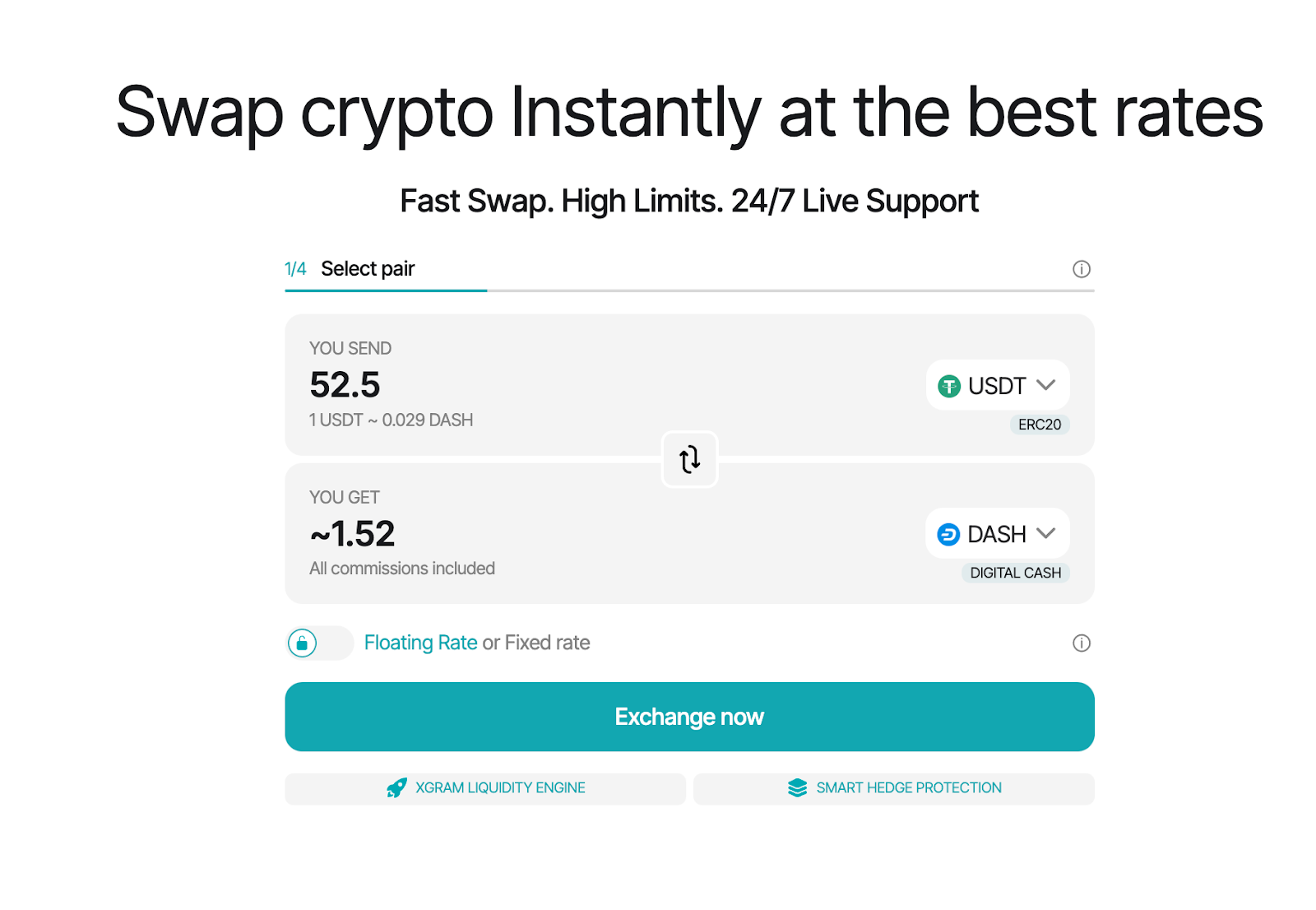
The process is designed to be straightforward.
- Go to the Xgram by following the link
- Choose the cryptocurrency you want to exchange
- Select Dash as the receiving asset
- Enter the amount
- Provide your wallet address
- Confirm the transaction and send funds
- Once the transaction is detected, the swap is processed automatically. In most cases, the entire process takes around 10–15 minutes.
Why this matters now
As the crypto market grows and matures, the driving force behind its long-term value is its usability.
Those assets that are not applicable in real life are likely to be phased out, and those that are usable and offer real functionality are becoming more and more part of our lives.
Dash has already made its mark in the market as it offers real functionality rather than just offering the potential to be useful.
The evolution of cryptocurrency is moving towards functionality.
No longer is the question asked of what something is, but rather how it is used.
Dash is answering that question quite clearly as it is centered on speed, accessibility, and usability.
As it is made accessible through tools like Xgram, it is not just the concept, but the reality.

Private crypto swaps
Best rates. Secure. Wallet to wallet

 5 Min
5 Min