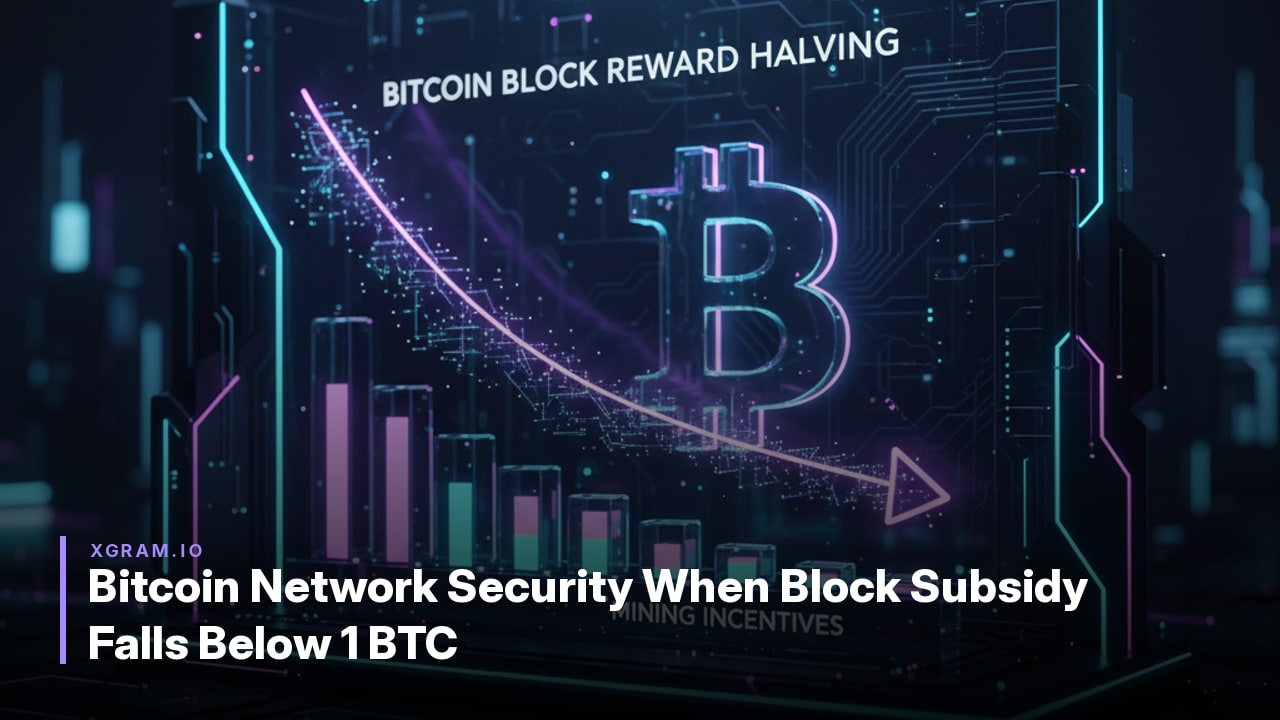
Bitcoin Network Security When Block Subsidy Falls Below 1 BTC


By Nina Kovač · Reviewed by Gabriel Moreau
Quick Summary
- Bitcoin network security halving refers to the reduction of block subsidies, impacting miner incentives.
- As of August 19, 2026, the block subsidy is approaching 1 BTC, influencing long-term security dynamics.
- The transition to a fee-dominated security model is critical for sustaining the network.
- Hashrate resilience and attack resistance become pivotal as block rewards decline.
- Understanding this transition is essential for Bitcoin users and investors alike.
- Future predictions suggest evolving security measures will adapt by 2030 and beyond.
Definition: What is Bitcoin Network Security Halving?
Bitcoin network security halving refers to the event occurring approximately every four years, where the block subsidy awarded to miners for validating transactions is cut in half. This mechanism plays a crucial role in Bitcoin’s monetary policy, designed to reduce the rate of new bitcoins created and introduced into circulation. The halving events are significant because they influence the incentives for miners, who secure the network by validating transactions and maintaining the blockchain.
As the block subsidy decreases, miners will increasingly rely on transaction fees for their revenue. This transition raises important questions about the long-term security of the Bitcoin network, particularly as the subsidy approaches 1 BTC per block.
How does Bitcoin Network Security Halving work?
Bitcoin network security halving works through a predetermined schedule embedded in the Bitcoin protocol. Every 210,000 blocks mined (approximately every four years), the reward for mining a new block is halved. This reduces the rate of new bitcoin issuance, ultimately capping the total supply at 21 million coins. Here’s how it operates:
1. Block Reward Reduction
The block reward started at 50 BTC in 2009 and halved to 25 BTC in 2012, then to 12.5 BTC in 2016, and again to 6.25 BTC in 2020. The next halving is expected to occur in 2024, reducing the reward to 3.125 BTC.
2. Transition to Fee-Dominated Security
As the block reward decreases, miners will increasingly depend on transaction fees, which users pay to prioritize their transactions. This shift necessitates a robust market for transaction fees to ensure that miners remain incentivized to secure the network.
3. Impact on Hashrate and Network Security
Hashrate, or the total computational power of the network, plays a critical role in maintaining security. A decline in the block subsidy could lead to less hashrate if miners find it economically unviable to continue mining, potentially increasing vulnerability to attacks.
4. Long-term Security Implications
As the block subsidy approaches 1 BTC, the implications for long-term network security become significant. Bitcoin's ability to maintain a secure network will increasingly depend on user adoption, transaction volume, and fee structures that can support miner incentives.
Why does Bitcoin Network Security Halving matter?
Understanding Bitcoin network security halving is crucial for several reasons:
- Incentive Structure: The halving directly impacts miner incentives, which are vital for network security. Miners secure the network by validating transactions; if incentives dwindle, security may be compromised.
- Transaction Volume: A robust transaction volume is imperative to ensure that miners can earn sufficient fees to continue operating profitably as block rewards decline.
- Market Signals: The market's response to halvings often influences Bitcoin's price, impacting the overall ecosystem and user confidence.
- Future Projections: As we approach 2030, the transition to a fee-driven model will determine the long-term viability and resilience of the Bitcoin network.
Is Bitcoin Network Security Halving safe?
Bitcoin network security halving presents both risks and opportunities. The primary concern is that as subsidies decrease, miner incentives might weaken, which could lead to lower hashrate and increased vulnerability to potential attacks. However, if transaction fees rise adequately to compensate for the reduced block subsidy, the network can maintain its security.
Moreover, the decentralized nature of Bitcoin means that miners worldwide contribute to the network's integrity. This diversification can help mitigate risks associated with declining subsidies. Ultimately, the safety of the network will depend on user participation and the adaptability of miners to changing economic conditions.
Bitcoin Network Security Halving vs. Other Cryptocurrencies
| Feature | Bitcoin | Ethereum | Litecoin |
|---|---|---|---|
| Origin | 2009 | 2015 | 2011 |
| Block Subsidy | Halves every 210,000 blocks | No fixed subsidy; transaction fees are main incentive | Halves every 840,000 blocks |
| Total Supply | 21 million BTC | No capped supply | 84 million LTC |
| Security Model | Block subsidy + transaction fees | Transaction fees primarily | Block subsidy + transaction fees |
| Mining Algorithm | SHA-256 | Ethash (transitioning to PoS) | Scrypt |
| Halving Events | Every 4 years | N/A | Every 4 years |
Pros and Cons
- Pros:
- Reduces supply inflow, creating scarcity.
- Encourages miner efficiency and innovation.
- Potentially increases bitcoin's value over time.
- Cons:
- May weaken miner incentives during transition.
- Potential for increased transaction fees if demand is not sufficient.
- Risk of reduced hashrate leading to security vulnerabilities.
Where can I buy Bitcoin?
Bitcoin can be purchased on major centralized exchanges, decentralized exchanges, and registration-free swap services like Xgram.io. Xgram offers a seamless experience for crypto swaps without creating an account, allowing users to quickly acquire Bitcoin while benefiting from fast swaps and identity verification may be requested in specific compliance-related situations. This makes it an ideal platform for those looking to engage with Bitcoin amid evolving market conditions.
Risks and considerations
Investors and users should consider several risks related to Bitcoin network security halving:
- Potential for reduced miner participation affecting network security.
- Fluctuating transaction fees may deter users from using the network.
- Market volatility can lead to price fluctuations, impacting overall adoption.
- Increased competition among miners as fee-based incentives become more critical.
FAQ
What is the block subsidy in Bitcoin?
The block subsidy is the reward miners receive for validating transactions, which halves approximately every four years during a halving event.
How often does the Bitcoin halving occur?
The Bitcoin halving occurs every 210,000 blocks, roughly every four years.
What happens to miner incentives after the halving?
Miner incentives transition from block rewards to transaction fees, which must rise to maintain network security as subsidies decrease.
Is Bitcoin secure after the block subsidy falls below 1 BTC?
Bitcoin's security can remain intact if transaction fees adequately compensate miners for their work, but risks exist if fees do not increase.
How does the halving affect Bitcoin's price?
Historically, Bitcoin's price tends to increase after halvings, driven by reduced supply and heightened demand.
What is the long-term outlook for Bitcoin security?
The long-term outlook will depend on user adoption, transaction volume, and the ability of the network to adapt to a fee-dominated security model.
Sources
Official project documentation: protocol specifications and halving mechanics, accessed August 19, 2026.
CoinMarketCap / CoinGecko: current price, market cap, and circulating supply data, accessed August 19, 2026.
Industry publications (e.g., CoinDesk, The Block): news and analysis on halving events and security implications, accessed August 19, 2026.
Project whitepaper: detailed outline of Bitcoin's monetary policy and halving schedule, accessed August 19, 2026.
Cryptocurrency forums and discussions: community insights on mining and network security, accessed August 19, 2026.
This is not financial advice.

Private crypto swaps
Best rates. Secure. Wallet to wallet


 5 Min
5 Min